
There are five different types of bus stops in the county. We call it five different levels based on different sets of equipment.
Stop compared to stop points
A stop point is the part of the stop where the bus departs from. A stop can have several stop points. A travel center has, for example, several stop points as there are many routes that must converge at the same stop. A smaller stop along a road usually has two stop locations; one in each direction.
Five different levels of stops
Citylinjen is part of a public transport system known as BRT. The buses run in dedicated bus lanes. There are rules about what facilities must be provided at the stops.
Citylinjen stops can be found on certain routes in Örebro. A Citylinjen stop must include the following:
-
Accessible platform, including tactile paving, a visual guidance strip and an R17 kerb.
-
Lighting around the stop area.
-
Bicycle parking.
-
A litter bin.
-
A bus shelter.
-
A timetable and other travel information, including information for people who are blind or partially sighted.
-
Real-time information showing where the bus is right now, not just the timetable.
-
Digital information displays.
-
A talking timetable that announces when the bus departs.
The picture below shows an example of a BRT stop in the city of Örebro.
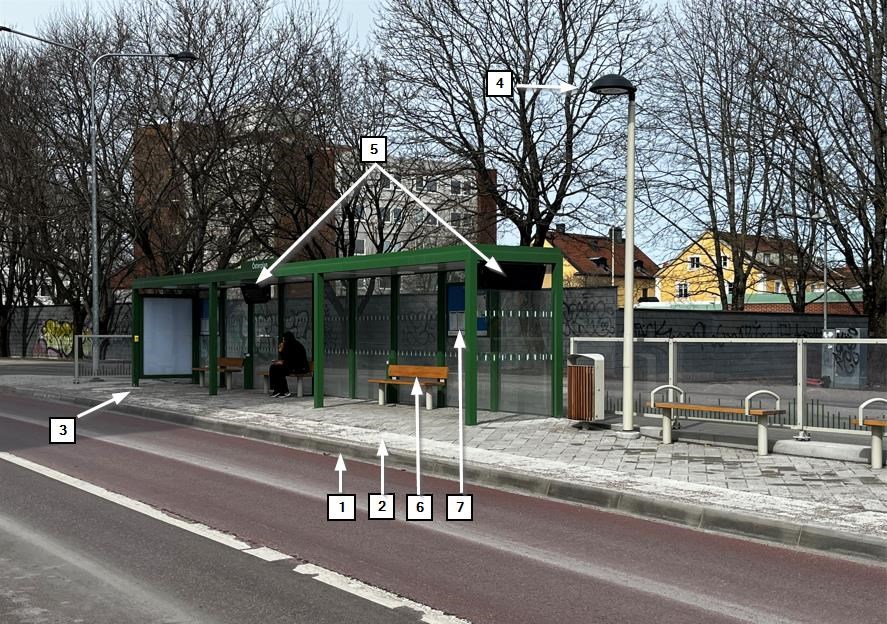
1. Bus edge support of 17 cm and of variant R17
2. Visual guidance
3. Tactile guide line
4. Lighting at the bus stop area
5. Live time. Information about where the bus is in the present tense. Digital information.
6. Bus shelter
7. Timetable and any other traveler information, including information for people who are blind or partially sighted.
Level one - Travel center and major stops at hubs
Level one includes bus stops at travel centers, major interchanges and stops with over 200 boarding passengers per weekday, Monday to Friday, excluding public holidays.
Equipment to be found at level three is:
Equipment to be found at level one is:
- Accessibility platform, which includes tactile path, visual path and curb type R17
- Lighting in the area around the stop
- Bicycle parking
- Wastebasket
- Bus shelter
- Timetable and any other traveler information, including information for people who are blind or partially sighted.
- Live time. Information about where the bus is in the present tense, not just timetable time
- Digital information
- A talking timetable that announces when the bus departs.
The image below shows an example for a level one stop.
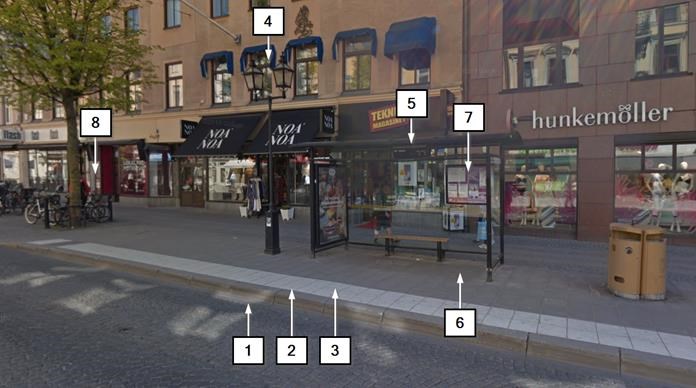
1. Bus edge support of 17 cm of variant R17
2. Visual guidance
3. Tactile guide line
4. Lighting at the stop area
5. Live time. Information about where the bus is in the present tense. Digital information.
6. Bus shelter
7. Timetable and any other traveler information, including information for people who are blind or partially sighted.
8. Bicycle parking adjacent to the bus stop. This is not a requirement today, but is available at several bus stops.
Level two - Larger stops 20 - 200 boardings
Level two are larger bus stops with 20 to 200 boarding passengers per weekday, Monday to Friday, excluding public holidays.
Equipment to be found at level three is:
Equipment that must be on level two is:
- Accessibility platform, which includes tactile path, visual path and curb type R17
- Lighting in the area around the stop
- Bicycle parking
- Bus shelter
- Timetable and any other traveler information, including information for people who are blind or partially sighted.
The image below shows an example of a level two stop.
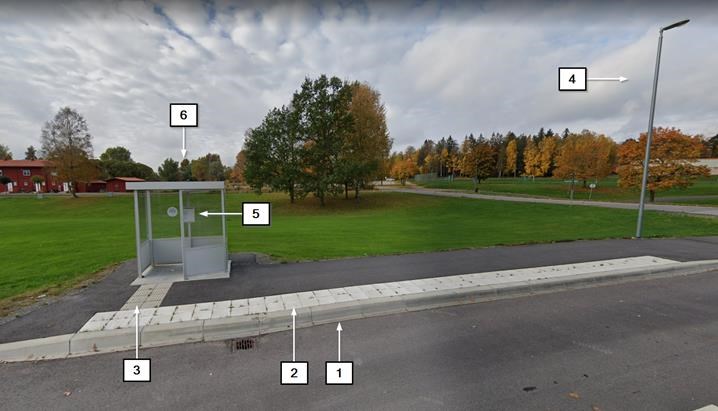
1. Bus edge support of 17 cm of the variant R17
2. Visual guidance
3. Tactile guide line
4. Lighting at the stop area
5. Bus shelter
6. Timetable and any other traveler information, including information for people who are blind or partially sighted.
Level three - Stop with 10 - 20 boardings
Level 3 stops have between 10 and 20 boarding passengers per weekday, Monday to Friday, excluding public holidays.
Equipment to be found at level three is:
- Accessibility platform, which includes tactile path, visual path and curb type R17.
- Top board. An information board at the top of the stop post showing the name of the stop and which stop location it is.
- Timetable and any other traveler information, including information for people who are blind or partially sighted.
The image below shows an example of a level three stop.
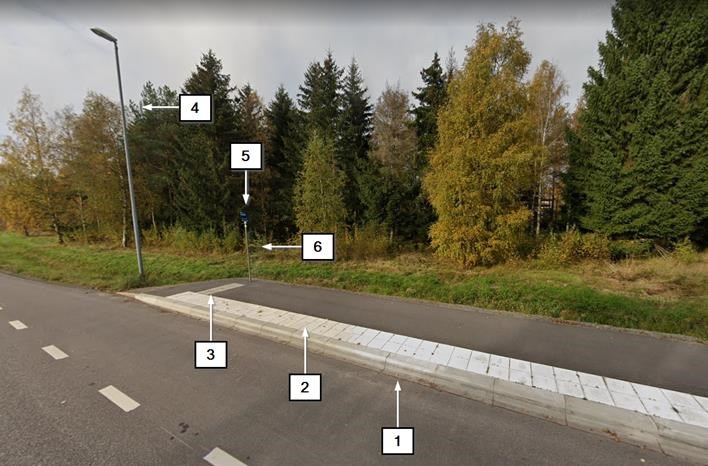
1. Bus edge support of 17 cm of variant R17
2. Visual guidance
3. Tactile guide line
4. Lighting at the stop area
5. Stop pole with top board
6. Timetable and any other traveler information, including information for people who are blind or partially sighted.
Level four - Fewer than 10 boardings per day
Level four is for stops that have less than ten boarding passengers per weekday, Monday to Friday, excluding public holidays.
Equipment to be found at level three is:
- Boarding and disembarking area of at least 1.5 m.
- Top board. An information board at the top of the stop post showing the name of the stop and which stop location it is.
The image below shows an example for a stop on level four located at a branch road.
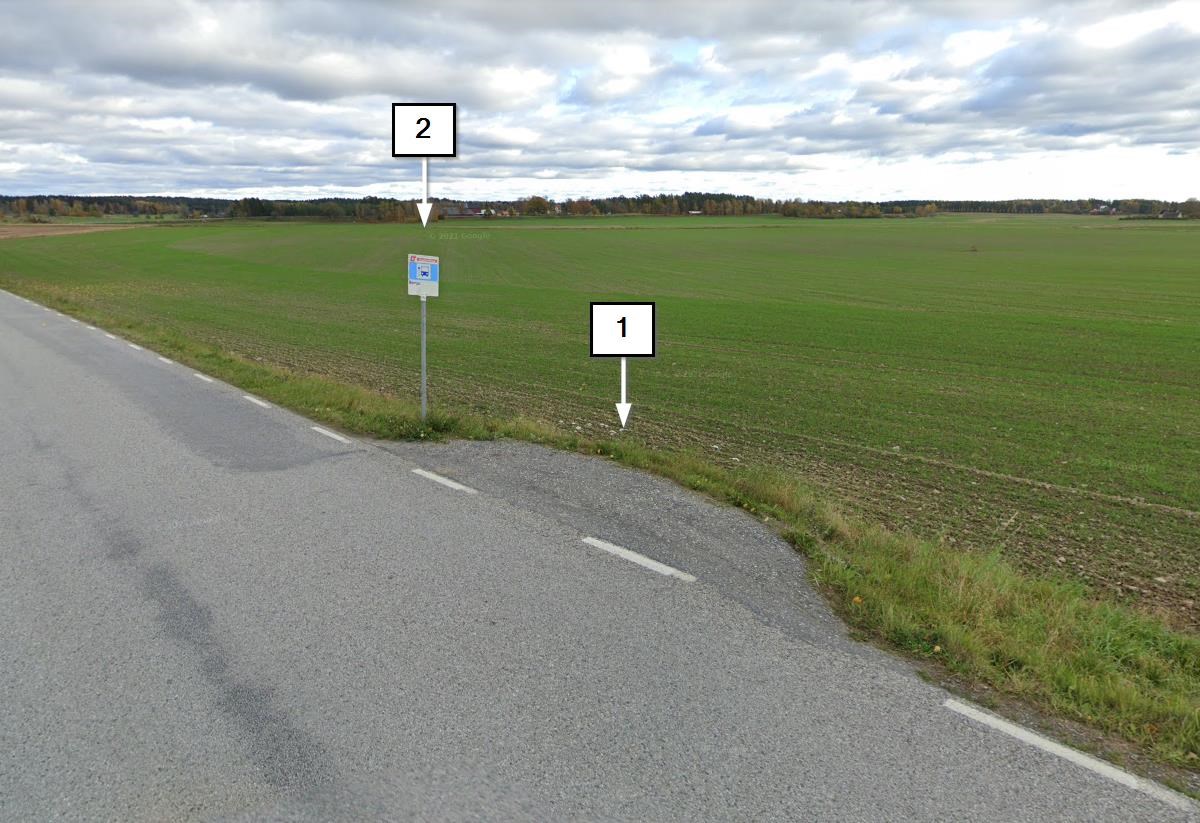
1. Boarding and disembarking area of at least 1.5 x 1.5 metres.
2. Stop pole with top board.
The image below shows an example of a Level 4 stop located on a nearby road.
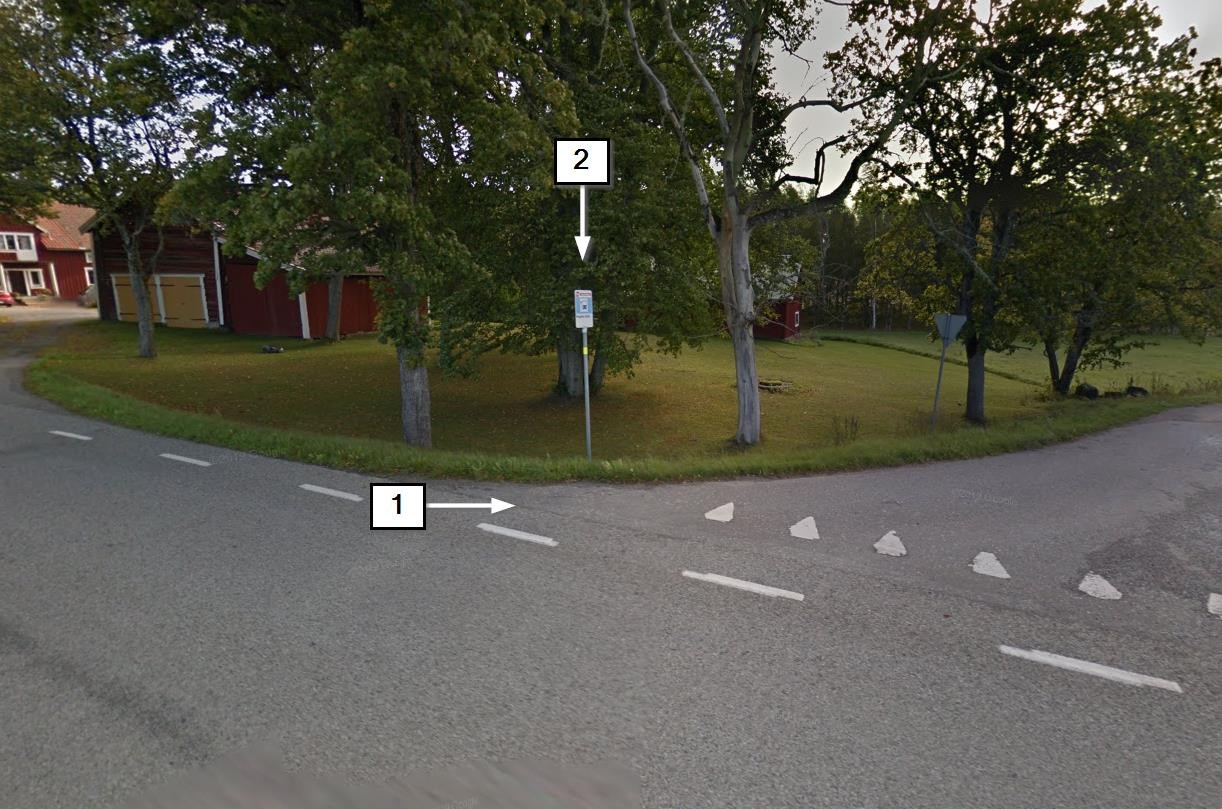
1. Getting on and off with a standing surface on the adjacent road
2. Stop pole with top board
-
Level BRT - Bus Rapid Transit
BRT stands for Bus Rapid Transit and is a public transport system with partially separate lanes for buses. In this system, there are directives for how a bus stop should be equipped. Today we have BRT stops in connection to Citylinjen.
Stops at this level are today found along certain routes within the city of Örebro.
Equipment that must be present at a BRT stop is:
- Accessibility platform, which includes tactile guidance, visual guidance and curb type R17
- Lighting in the area around the stop
- Bicycle parking
- Wastebasket
- Bus shelter
- Timetable and any other traveler information, including information in Braille
- Live time. Information about where the bus is in the present tense, not just timetable time
- Digital information
- "Prator" - where you as a traveler can have information about upcoming departure times read out to you
The picture below shows an example of a BRT stop in the city of Örebro.
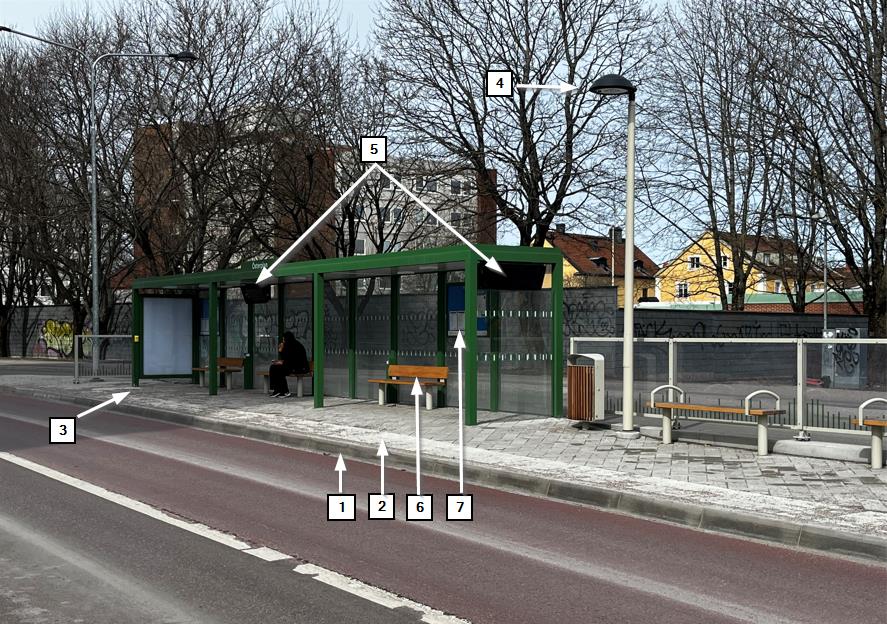
1. Bus edge support of 17 cm and of variant R17
2. Visual guidance
3. Tactile guide line
4. Lighting at the bus stop area
5. Live time. Information about where the bus is in the present tense. Digital information.
6. Bus shelter
7. Timetable and any other traveler information, including information in Braille.
-
Level one - Travel center and major stops at hubs
Level one includes bus stops at travel centers, major interchanges and stops with over 200 boarding passengers per non-holiday Monday to Friday.
Equipment to be found at level one is:
- Accessibility platform, which includes tactile path, visual path and curb type R17
- Lighting in the area around the stop
- Bicycle parking
- Wastebasket
- Bus shelter
- Timetable and any other traveler information, including information in Braille
- Live time. Information about where the bus is in the present tense, not just timetable time
- Digital information
- "Prator" where you as a traveler can have information about upcoming departure times read out to you
The image below shows an example for a level one stop.
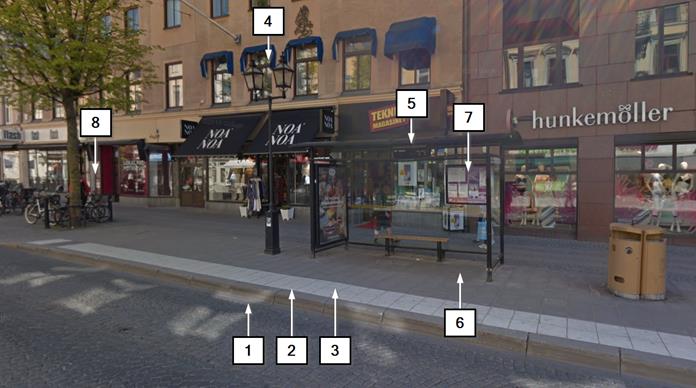
1. Bus edge support of 17 cm of variant R17
2. Visual guidance
3. Tactile guide line
4. Lighting at the stop area
5. Live time. Information about where the bus is in the present tense. Digital information.
6. Bus shelter
7. Timetable and any other traveler information, including information in Braille.
8. Bicycle parking adjacent to the bus stop. This is not a requirement today, but is available at several bus stops.
-
Level two - Larger stops 20 - 200 boardings
Level two are larger bus stops with 20 to 200 boardings non-weekend Monday to Friday.
Equipment that must be on level two is:
- Accessibility platform, which includes tactile path, visual path and curb type R17
- Lighting in the area around the stop
- Bicycle parking
- Bus shelter
- Timetable and any other traveler information, including information in Braille.
The image below shows an example of a level two stop.
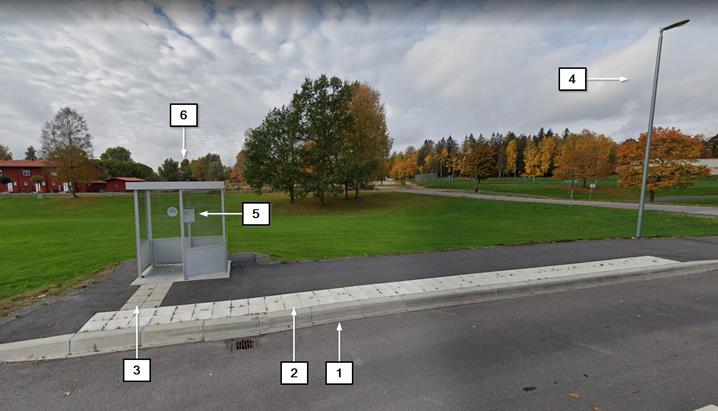
1. Bus edge support of 17 cm of the variant R17
2. Visual guidance
3. Tactile guide line
4. Lighting at the stop area
5. Bus shelter
6. Timetable and any other traveler information, including information in Braille.
-
Level three - Stop with 10 - 20 boardings
Level three are stops with between 10 and 20 boarding passengers per non-weekend Monday to Friday.
Equipment to be found at level three is:
- Accessibility platform, which includes tactile path, visual path and curb type R17.
- Top board. An information board at the top of the stop post showing the name of the stop and which stop location it is.
- Timetable and any other traveler information, including information in Braille.
The image below shows an example of a level three stop.
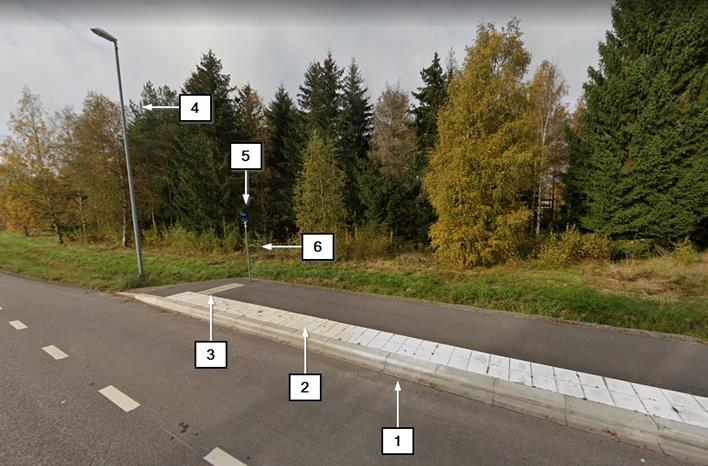
1. Bus edge support of 17 cm of variant R17
2. Visual guidance
3. Tactile guide line
4. Lighting at the stop area
5. Stop pole with top board
6. Timetable and any other traveler information, including information in Braille.
-
Level four - Fewer than 10 boardings per day
Level four is for stops that have less than ten boardings per non-holiday Monday to Friday.
Equipment to be found at level four is:
- Boarding and disembarking area of at least 1.5 m.
- Top board. An information board at the top of the stop post showing the name of the stop and which stop location it is.
The image below shows an example for a stop on level four located at a branch road.
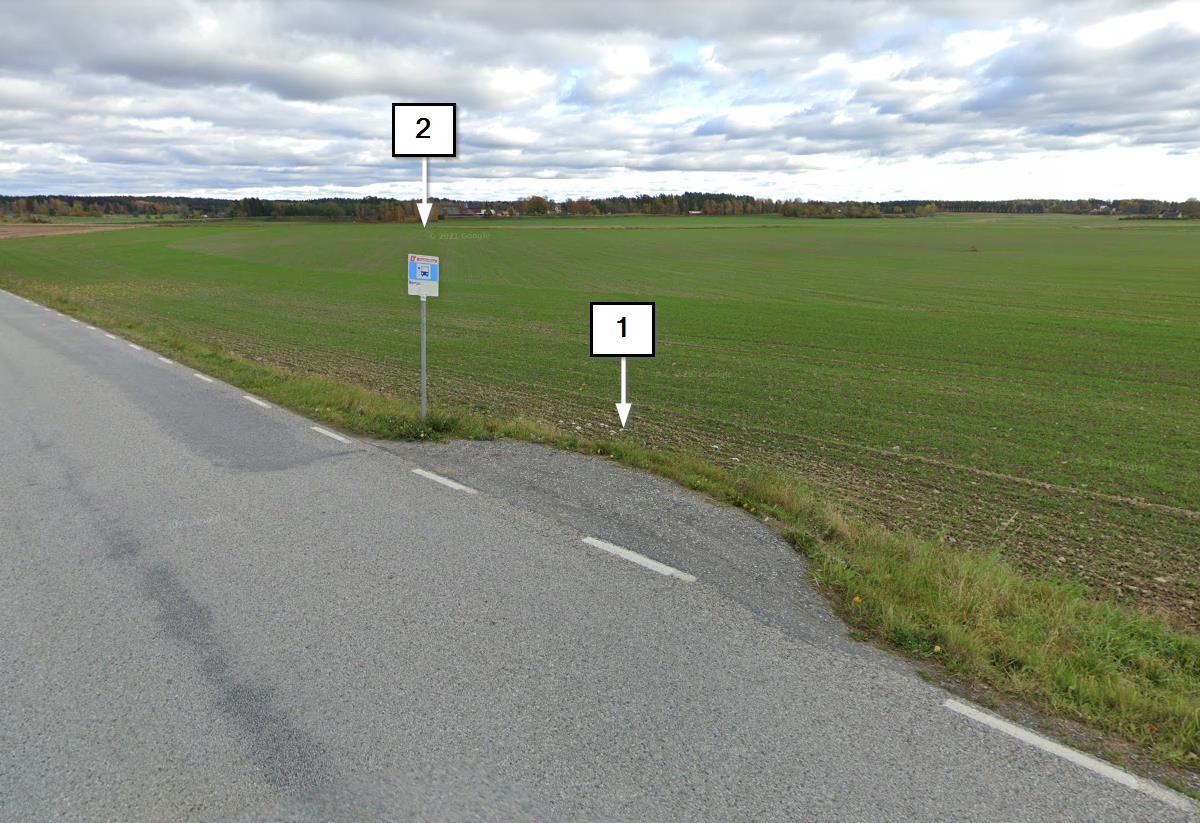
1. Boarding and disembarking area of at least 1.5 x 1.5 metres.
2. Stop pole with top board.
The image below shows an example of a level four stop located on an adjacent road.
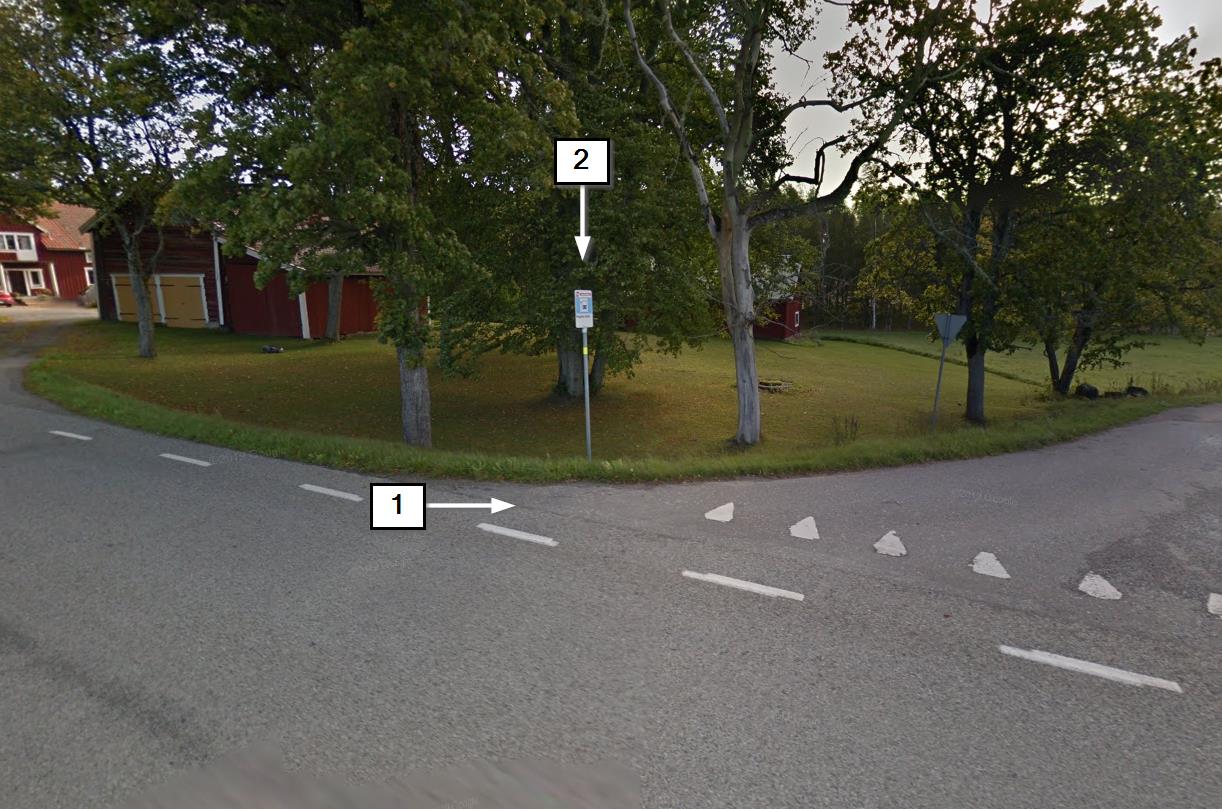
1. Getting on and off with a standing surface on the adjacent road
2. Stop pole with top board